Physics is one subject that almost every FRCR aspirant fears at some point. Not because the concepts are impossible, but because the questions are unpredictable. One small statement changes the entire meaning of an MCQ, especially when multiple options can be correct.
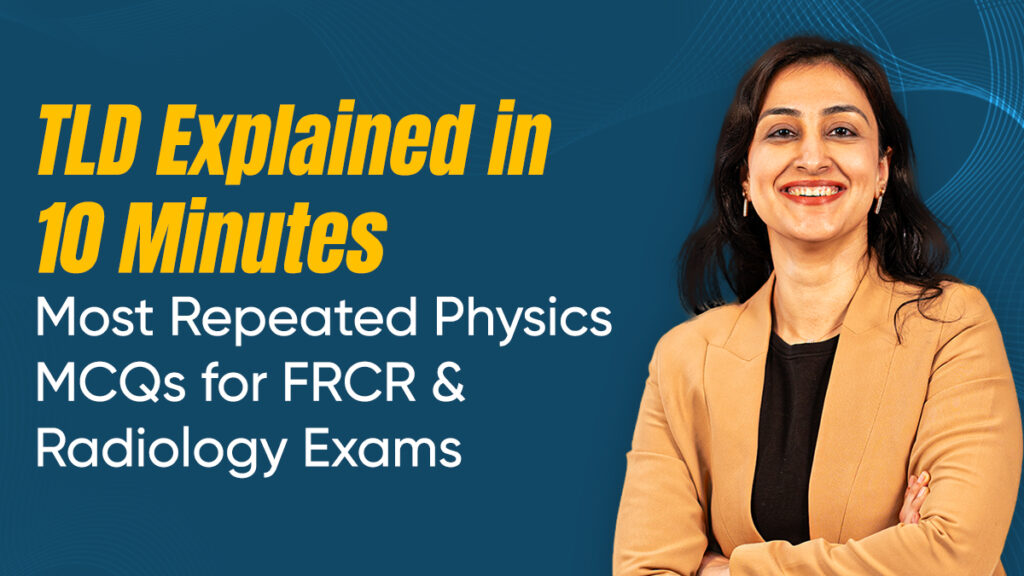
That is exactly why sessions like this by Dr. Zainab Vora become so valuable. Instead of memorizing facts blindly, the focus is on understanding why an option is true or false.
In this session, Dr. Zainab breaks down one of the most commonly misunderstood topics in radiation physics — the Thermoluminescent Dosimeter (TLD) — in a way that actually makes sense.
Why TLD Questions Confuse Everyone?
TLD is one of those topics students often “read once and forget.” But in exams like FRCR, FMGE, INI-CET, or radiology vivas, even basic-looking TLD questions can become tricky.
The reason?
Because examiners rarely ask direct definitions. Instead, they ask tiny conceptual points like:
- Does TLD measure dose rate?
- Can it be reused?
- What material is it made of?
- What does the glow curve represent?
- Which filters are used?
And suddenly, a simple topic starts feeling confusing.
So, What Exactly Is a TLD?
A Thermoluminescent Dosimeter is a device used to measure radiation exposure.
The concept sounds complicated at first, but it is actually very logical. When radiation hits the TLD material, electrons inside it absorb energy and move to a higher energy state. These electrons get trapped there.
Later, when the TLD is heated, those trapped electrons return to their normal state and release energy in the form of light. That released light tells us how much radiation exposure occurred.
The entire principle can be summarized through thermoluminescence:

The greater the radiation exposure, the greater the emitted light.
Simple.
The Most Commonly Asked TLD MCQs
1. Is TLD Used with Filters?
Yes.
TLD badges contain different windows with different filters.
These filters help identify different types of radiation exposure.
The commonly used filters are:
- Aluminum
- Copper
- Perspex plastic
One window is usually left open without a filter.
This setup helps differentiate between alpha, beta, gamma, and X-rays.
2. What Is TLD Made Of?
One of the most repeated mistakes in MCQs is confusing lithium fluoride with lithium iodide.
The correct answer is:
- Lithium fluoride
- Calcium sulphate activated with dysprosium
Lithium iodide does not have thermoluminescent properties.
That single word change is enough to make students lose marks.
3. Does TLD Measure Dose Rate?
Ans. No.
And this is where many students get trapped.
TLD measures the cumulative radiation dose, not the rate at which radiation exposure happened.
For example, healthcare workers wear TLD badges over a period of time, usually around three months. The badge then gives the total accumulated exposure during that duration.
So remember:
TLD=Cumulative Dose Measurement
Not dose rate.
4. Why Is TLD Considered Reliable?
Ans. One major advantage of TLD is its linear response over a wide dose range.
That means whether radiation exposure is low or high, the response remains proportional and accurate.
The effective working range is approximately:
0.1 mSvto2000 mSv
This wide linear range is one of the strongest features of TLD.
5. Can TLD Be Reused?
Ans. Yes, absolutely.
After reading the radiation exposure, the TLD is heated to a very high temperature. This process releases all trapped electrons and resets the material back to its original state.
This process is called annealing.
Once annealed, the TLD can be reused again.
Understanding the Glow Curve
Another favorite viva question is:
What does the glow curve represent?
The answer is:
- Light intensity versus temperature
As temperature increases during heating, emitted light changes accordingly. The area under this curve represents the total emitted light, which directly corresponds to radiation exposure.
The Real Trick Behind TLD Questions
The topic itself is not difficult.
The challenge is that every single line can become a separate MCQ.
A statement that looks harmless can completely change the answer.
That is why conceptual revision matters far more than rote learning in physics.
Dr. Zainab’s teaching style works because she simplifies these ideas into practical understanding instead of forcing students to memorize isolated facts.
Quick High-Yield TLD Revision
Before exams, these are the points you should remember:
- TLD stands for Thermoluminescent Dosimeter
- Measures cumulative radiation dose
- Made of lithium fluoride
- Can also use calcium sulphate with dysprosium
- Uses aluminum, copper, and plastic filters
- Has a wide linear dose response
- Reusable after annealing
- Glow curve represents light intensity versus temperature
- Heating temperature is around 300–400°C
Final Thoughts
Physics becomes manageable when concepts are explained clinically and logically instead of being treated like pure theory.
And honestly, that is the biggest takeaway from sessions like these.
Instead of fearing FRCR physics MCQs, students should focus on understanding the “why” behind every option. Once the concepts become visual and practical, even difficult-looking questions start feeling straightforward.
Sometimes, one well-explained 10-minute revision session is more useful than hours of passive reading.